


Axia Futures – Futures Trading and Trader Development
-
 Last Updated: 11-19-2022
-
 Duration: 12.97 hour(s), 30 video(s)
-
 Size: 3.8 GB
$49
Buy More, Save More!
2 Courses
10% OFF
3 Courses
15% OFF
5 Courses
30% OFF
Why Choose TSCourses?
-
 Learn online or download via Google Drive
-
 All course files are included
-
 Free course updates via email
-
 Seen it cheaper? We'll beat the price
Course Description
If you are serious about mastering futures trading from the ground up, Axia Futures – Futures Trading and Trader Development is one of the most structured, “desk-level” training experiences you can get online. It is built by active proprietary traders, not armchair theorists, and is designed specifically to shape you into a consistent intraday futures trader.
In this in-depth review, we will unpack who is behind Axia, what you really learn inside the Futures Trading and Trader Development course, and what real students are saying about it. Then we will show you how TSCourses lets you access this premium training at the lowest possible cost, with instant delivery and a 15-day satisfaction guarantee.
Who is Axia Futures – and why do traders respect them?
Axia Futures is a London-based proprietary trading firm and education company focused on developing intraday futures traders on major global markets. Their trainers are real prop traders who spend their days trading order flow, volume, and macro events, then codify what works into structured training.
What sets Axia apart is that their courses are not generic “how to trade” videos. Their flagship in-house programme, the 6-Week Career Training Programme, is the same structure they use to train and back traders on their own trading floors. Students regularly comment that the training is far more intense, practical, and structured than any retail course they encountered before.
In interviews and testimonials, trainees describe being immersed in:
• Real-time replay of key events like CPI, FOMC, and central bank decisions to understand how futures markets really move
• Routines and debrief processes used daily by professional prop traders
• A culture that treats trading as a performance game – systematic, data-driven, and brutally honest
This “desk reality” mindset is exactly what the Futures Trading and Trader Development course is built to deliver to remote traders.
Inside the Axia Futures – Futures Trading and Trader Development course
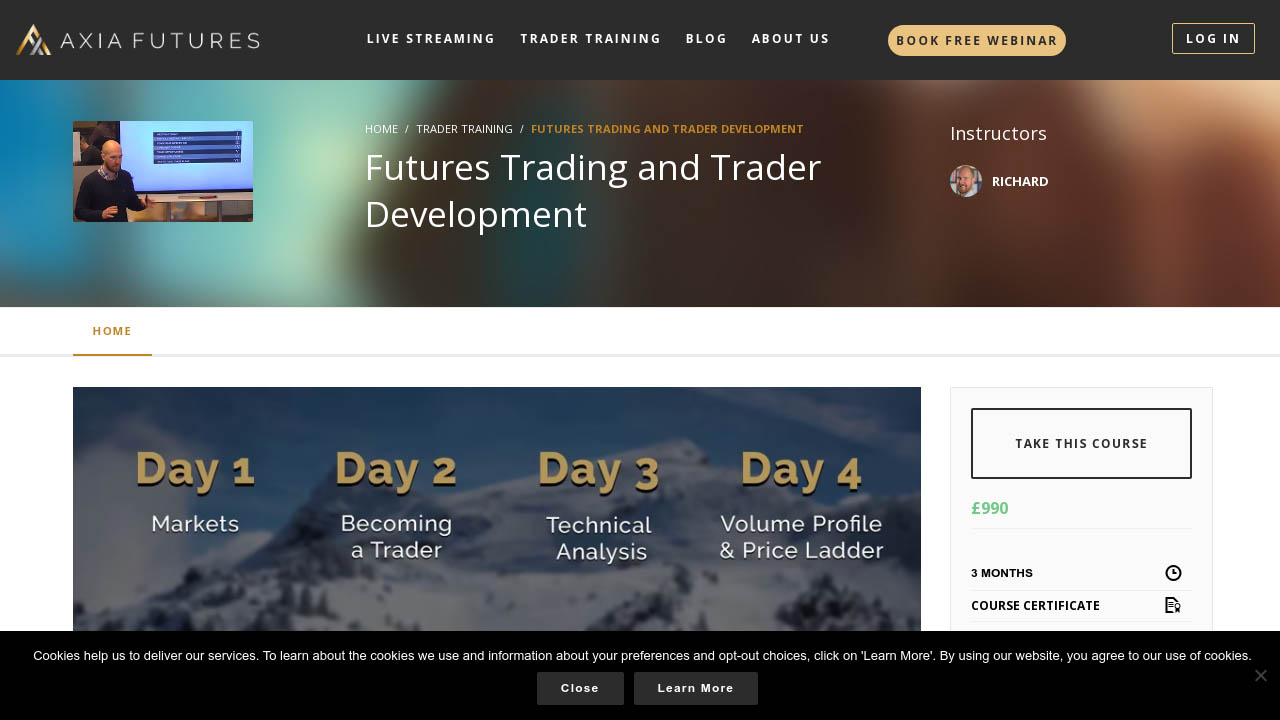
Futures Trading and Trader Development is a structured foundations-to-execution training, laid out over a series of “day” modules. It is ideal if you want to either start from scratch in futures or rebuild your approach on institutional-grade principles.
Here is how the curriculum unfolds:
Introduction
You start with an orientation to the futures trading landscape and Axia’s philosophy. The goal is to reset your expectations: trading is a performance career, not a get-rich-quick scheme. From the beginning, the course frames you as a developing professional, not a gambler.
Day 1 – Markets
This module gives you a clear understanding of:
• What futures markets are and how they function
• The main contracts and asset classes professional intraday traders focus on
• How liquidity, volatility, and market microstructure affect your edge
This is foundational, but Axia’s twist is to keep everything tied to how you will actually make decisions intraday, rather than abstract theory.
Day 2 – Becoming a Trader
Here Axia leans into trader development, not just chart patterns:
• What it means to think like a prop trader versus a retail speculator
• The realities of learning curves, drawdowns, and deliberate practice
• How to develop routines, goals, and review systems that compound skill over time
Students on Axia’s live programmes often say this mindset and routine work was the biggest surprise – and the biggest edge – they gained. Many came expecting just strategies; they left understanding they needed a professional process.
Day 3 – Technical Analysis
Instead of dumping a list of indicators, Axia focuses on:
• Price action as the primary language of the market
• Key technical structures relevant to futures: support/resistance, trend, key levels
• How to integrate technical context with volume, order flow, and catalysts
The aim is not to create a “chart artist” but a trader who can define context clearly and quickly during the session.
Day 4 – Volume Profile and Price Ladder
This is where Axia really differentiates itself.
Professional futures traders live and die by their understanding of:
• Volume profile: where meaningful volume traded, how the auction built value, and where acceptance versus rejection zones sit
• The price ladder (DOM): real-time order flow, liquidity shifts, and trade execution at the micro level
Axia is known for its depth in volume and order flow training. Students regularly highlight the way they practice on replays of prior events, analysing how the ladder and volume profile evolved and where opportunities really were – not where hindsight suggests they were.
Day 5 – Fundamental Analysis
Unlike many retail courses, Axia does not ignore macro and fundamental drivers. In this module you learn:
• How economic data, earnings, and macro flows drive intraday behaviour in futures
• Which releases and themes truly matter for specific instruments
• How to prepare a daily plan around key scheduled events
This is crucial for trading instruments like equity index futures, bonds, and commodities where macro is often the primary driver of volatility.
Day 6 – Central Banks
Axia dedicates a full day to central banks because in modern markets, central bank policy is often the main story.
You learn:
• How central bank decisions and communication impact bonds, equity indices, and FX futures
• How to structure trades around FOMC, ECB, BOE, and other major events
• How to manage risk around high-volatility, binary-style news events
In their live programmes, trainees practice prior FOMC or CPI days on replay, learning how to read the chaos of the ladder and price action in real time. This course reflects that same philosophy: prepare like a prop desk, not a hobbyist.
Day 7 – Style and Strategy
At this stage, Axia helps you move from “information” to “identity”:
• Different intraday futures styles: scalping, short-term swings, news trading, order-flow driven trades
• How to choose a style that matches your psychology, schedule, and risk tolerance
• How to build a playbook of repeatable setups structured around context, trigger, risk, and management
This moves you away from random trade-taking into executing a defined edge repeatedly.
Day 8 – Debrief and Improvement
This is one of the most important, and most neglected, parts of trader development.
Axia shows you:
• How to debrief each trading session like a professional trader on a desk
• What data to track (screenshots, metrics, journaling) and how to use it to refine your edge
• How to run experiments on your trading to systematically improve
Trainees from Axia’s floor-based programmes often highlight how much time senior traders spend after the close, walking through their sessions in detail. That culture of meticulous review is baked into this module.
Day 9 – Summary
The final day pulls everything together into a coherent development roadmap:
• How to sequence your learning and practice over the coming months
• How to build and refine your trading business plan
• How to continue developing your edge instead of hopping from strategy to strategy
In total, the course includes 24 lessons plus quizzes to anchor the learning. It is dense, but in a structured, logical way that mimics how a prop firm would onboard and develop a junior trader.
Real student feedback and reputation
Because Axia runs both in-house prop training and online courses, feedback is widely discussed in trading communities, YouTube interviews, and forums.
Here are recurring themes from student experiences:
Positive feedback
• Professional environment and mentality: Many students comment that Axia is the first time they felt they were “on a real desk,” either virtually or physically. The routines, language, and expectations feel institutional, not retail.
• Depth of market and event training: Trainees praise the heavy focus on replaying CPI, FOMC, and other key events, analysing what really happened rather than relying on theory. This gives them a realistic feel for volatility and order flow.
• Structure and intensity: Several traders mention that the course – especially the 6-week in-house version – was more demanding, systematic, and “serious” than they expected. This is not light entertainment content; it is real skill-building.
• Direct access to prop-trader thinking: Those who interacted with Axia traders on the floor report long post-session discussions, breakdowns of setups, routines, and risk management approaches. Even online, the course reflects that practical, battle-tested mindset.
Common cautions
• Not a magic bullet: Traders emphasise that Axia gives you the tools, but you still need to put in the screen time and deliberate practice. Some note that expecting to be funded or instantly profitable after a single course is unrealistic.
• Requires commitment: The material, especially if you do all replays and drills, is intense. This is ideal if you are serious, but may feel overwhelming to casual learners.
Overall, Axia’s reputation in serious trading circles is that of a demanding, authentic prop-style training provider. That makes their Futures Trading and Trader Development course particularly attractive if you want to build a professional foundation, not just pick up a few chart patterns.
Who is this course best for?
This course is a strong fit if:
• You are an aspiring intraday futures trader who wants a complete, structured foundation
• You already trade but feel your approach is scattered, overly indicator-based, or lacking in order flow and event understanding
• You are transitioning from swing or position trading to intraday futures and need to understand how prop traders operate
• You are a student, entrepreneur, or professional looking to build a second skill with real structure, not YouTube randomness
It may be less suitable if:
• You are looking for automatic trading systems or “signal services”
• You cannot commit time to practice, replay, and journaling
• You want ultra-short, surface-level content instead
More courses you might like
TTC FOREX UNIVERSITY "EARLY ACCESS LAUNCH" 1 - I'm in search of 300 struggling merchants...

Van Tharp – Swing Trading Systems Video Home Study
Not only one, not simply three, however FIVE distinct Swing Trading Systems! You'll get to...
Noremac Newell Trading – Stock Trading Course
If you are serious about mastering day trading from someone who has actually done it...
BCFX 2.0 and 2.5 – Brandon Carter
If you are serious about turning forex and indices trading into a consistent skill rather...